Mittwoch, 24. Oktober 2018

Catalina - The building


As it is the sense of the project to fly a plane out of the air into water and back up in the air, I bought myself a so called flying boat. My choice was the Catalina from Dynam.
The Catalina is a “Flying Boat”. This means it has a Body like a ship and wings like a plane. Therefore it can land and start from water. This kind of plane was used in WW II. As Bombers, Rescue and transport planes. Some of them were incredibly huge. Today flying boats are mostly used for firefighting. The most famous of the firefighting planes is the Canadair_CL-415.

The fuselage after my first corrections
As I recieved my Catalina, I was very excited. My first plane able to land on water and swim. I’ve read tons of websites and saw many videos on youtube. One can not imagine all the things I wanted to modify. It should be completely waterproof, have one of the windows in the back able to be opened  so I could put a camera there and film in the passenger view, the floats should be able to be retractable and the whole plane should appear in dark black and bright orange / red.
Today I finished most of the plane. It has none of the above features. Let me show you why and how I managed the building.
By the time I unpacked the Catalina, I realized that the quality of the pre made steps was quite poor. The glue did not keep the plane together properly, the colour was already split off in some spots and the GFK parts on the bottom looked like they were glued on by me instead of a professional.
The white line is glue that I had to add
Most of all I was disturbed by those open gaps on the top of the fuselage. I used a specific glue for styrofoam and held the parts together with some duct tape. Then I left it for the night to dry. The next day as I removed the duct tape I had to realize that some of the colour stayed on the tape and left some ugly white stains on the plane.
The colour split off
As I got instructed in several forums, I shortened the carrier of the floats by two to four centimeters and put it in a steeper angle so it would not function as a hook in the water when the plane would be taking off or landing. To do this I cut the floaters open, removed the carriers, shortened them and glued all back together. As you can imagine, the floaters are barely yellow now.
Meanwhile I ordered a reciever from my trusted RC-Store. A great tool from Spektrum, created for full GFK planes with a big range and super fast data transmission. It was as expensive as it sounds.
When it arrived, I put the parts of the catalina together as it was written in the description.
The description was quite simple. Every step has it’s image and there are not that many parts that one could get a problem. I only made some minor mistakes that I could have avoided if I’d have read the instructions properly.
Former Y-Cable now extension
There is this thing with the servo cables that I would like to tell you.
The Catalina has a rudder, an elevator, two ailerons and two engines. In the wings there are two lights that you can turn on and off and set to blink or steady. In the package they deliver you one Y-Cable for the engines so they only take one slot of the reciever and one Y-Cable installed on the Rudder and the Elevator Servo Cables in the fuselage. Even with my little knowledge I knew that you can not put a Y-Calbe on these two Servos.
The Y-Cable takes the signal from the reciever and transmits it to two parts like for example the enginges. These two will therefore always run on the same speed. Or - if you combine the ailerons with a Y-Cable - the servos will always move in the same direction which makes the ailerons move in opposite directions because the servos are installed facing each towards its wing tip. If you combine the rudder and the elevator with the Y-Cable you will have some uncontrollable movement. For example if you put the Y-Cable on the Rudder slot, the rudder will go left and right while the elevator will go up and down accordingly. I should actually try that once I have an old plane ;)
So as I removed the Y-Cable from its wrong place, I thought the servo cables of the ailerons would be long enough so I cut one part of both of the Y-Cables off and used them to extend the cables from the engine to the reciever. Then I put one engine on the throttle slot. This will work as the normal enginge, providing the power to the reciever and getting the throttle signal. Then I took the second engine cable and cut off it’s red cable. The red cable is the + cable and brings power to the reciever. As I just said, the throttle cable already brings power. A second power source could damage the reciever. Then I put the second, castrated, engine on the gear. In the sender I used the “mixer” and put the following settings. 
Cut + Cable from one engine
  1. The gear does not have any lever or button as source. If it has a source, you will have trouble programming the following. Believe me, I tried.
  2. Throttle and gear move together.
  3. There are three flying modes: Flying, landing and water. As on my sender there’s no mode called “water”, I called this mode “throttle”. I put the three modes on a switch with three positions as one is always active.
  4. In mode flying, nothing special happens. The two engines move at the same pace.
  5. In mode landing, the ailerons move up. The exact percentage has yet to be found out. As default i put it to 75% while moving the elevator down for 10%. At this mode the ailerons have to go into the same direction so the servos will get different signals. Because of that I could not use the Y-Cable on the aileron servos.
  6. In mode throttle (water) the two engines move at a different rate as soon as I use the rudder. If the rudder goes to the left, the plane should move to the left. The right engine will turn 15% faster while the left engine will reduce its pace by 15%. Vice versa if the rudder moves to the right. This is used to steer the plane on water while the speed is to low for the rudder to have an effect. This was also the reason why I could not use the Y-Cable on the engines. They get different signals from the sender.
As I finished programming all this - with the Catalina  I learned the most about settings and programming my sender - I wanted to try it out. I installed my super expensive reciever in the plane, bound it to the sender and got an error “beep” from both the controllers. Something was wrong.
Reciever on a mount so it should not get wet in case water enters
Dynam is a chineese enterprise. The fuselage was in a bad quality so my first guess was:
Something is wrong with the engines or the controllers. After a bit of googling I found out that the problem might be the electricity. I tried  with an other battery but had the same result. I tried to bind again, switch on with the throttle stick up and so far and so far. Nothing worked. After some more googling I learned that this beep emits when the throttle slot of the reciever does not recieve the throttle signal from the sender. I then changed all kind of settings on the sender and put the throttle cable in every slot of the reciever. Still, nothing changed. As I ran out of ideas I asked my friends from the Club and their answer was as simple as it can be: If the engines turn with an other reciever, it’s the reciever… It was the reciever. This super glorious, super expensive peace of plastic just does not work. I have to admit I was a bit disappointed. Now there’s a cheaper reciever in the plane.

The last thing I changed was the running direction of one of the engines. As default, most engines run to the right. Once you turn on the throttle the plane will have a momentum to the left. If you have two enginges this momentum will increase. Not double because the engines are not on the same axis but still. To avoid this, one of the engines has to turn towards the left.
Right now I’m thinking: the left engine has to turn to the right and the left one to the left so they don’t  push / splash the water towards the fuselage but away from it… I’ll have to change that.

Today I’ll go to get the following parts from the store:

A set of propellers, one normal and one inverted (never use different propellers or engines on a multi engine plane. It might lead to crashes.)

As soon as I have these things installed I’ll run my first tests with my ugly but interesting flying boat. You’ll get videos and more pictures soon.
There might be a camera mounted on the front one day ;)
P.S.: The features I intended to build in were not made because of the bad quality of the package. I will test now if it is even waterproof and how it flies. Maybe later I can tune it a bit.
Propellers that run opposite each other are hard to find. I told my seller to find some but until now he did not confirm my order.


Mittwoch, 10. Oktober 2018

Flite Test

The more I fly (and right now I’m flying often) the more I feel the need for information. How does this work, what does that do.
Luckily I can always ask my fellow club members that are often flying for years but to get the latest ideas about it with an educational approach, I found “Flite Test”.
On this web site a young team of RC-Plane enthusiasts shows you how to build a plane from scratch, how to fly it and gives you tips about repairing. There’s also a forum where one can ask questions or publish his one ideas or projects.
Of course there are many other websites like RC NetworkVTH and others but they usually include a lot of reading or paying while on Flite Test there’s videos and a lot of free or at least cheap stuff.

Maybe, once Project Kingfisher becomes more realistic, I’ll publish it there aswell.

Oh and by the way:


Sonntag, 16. September 2018

Contest

Since my last post a lot of time past and a lot of things happended. I’m now slowly able to fly my Easyglider and bring it back to ground without crashing it. Also I can slowly detect thermal updrafts. Once for sure I will create a blog about weather and thermal updrafts.
Today I participated in a contest. It was just a contest within clubmembers but still it was my first contest and so I was curious about how things go.
As it was mostly for fun, any glider plane with an electric enginge could participate. The rules were simple. You take the engine for as long as you want to rise the plane as high as you want. Then you call the referee to start the clock. For three minutes you had to fly before landing in a designated area as close as possible to a marked target.
Already bringing the plane on a good level had it’s difficulties because there was some strong wind coming from south. Once up I failed twice out of four times to stay long enough. Once I landed after just two minutes and once I landed ten seconds before countdown. Still they gave me points.
The same was with my precision. I managed to land safely all the four times yet twice I had to turn on the engine again to bring the plane back up because I was too low too far. Even there, out of courtesy they gave me some points.
The result of the contest are yet to be calculated but I expect to be in the lower ranks. After all, I also was the rookie and the other members had some years of training but I recieved many compliments for my skills for someone flying only since some months.
After all it was a fun event. I will for sure try both, flying for a given time and land exactly on spot, some more until it comes naturally. I think this will help me a great deal for further progress.

Donnerstag, 19. Juli 2018

Improvements

“I’m too poor to buy cheap.” -Some guy on a forum about RC-Planes

It’s quite some time since I posted the last time and a lot of things happened ever since.

On one side I fixed the funman by ordering a new body. Luckily for me, the engine, the flight controler and two servos were already built in so I only had to add the reciever and the battery pack. Also I upgraded it by adding ailerons.

Picture in the Manual of the Easy Glider 4 with the most important expressions
On an other point I bought a real beginner plane. The Multiplex Easy Glider 4. It was not only the recommendation of the seller but also of some guy I met at the store. This guy told me that the Easy Glider 4 is a very simple Plane, perfect for beginners and - if I wish - he could show me some the basics.
Easy Glider 4 by Multiplex
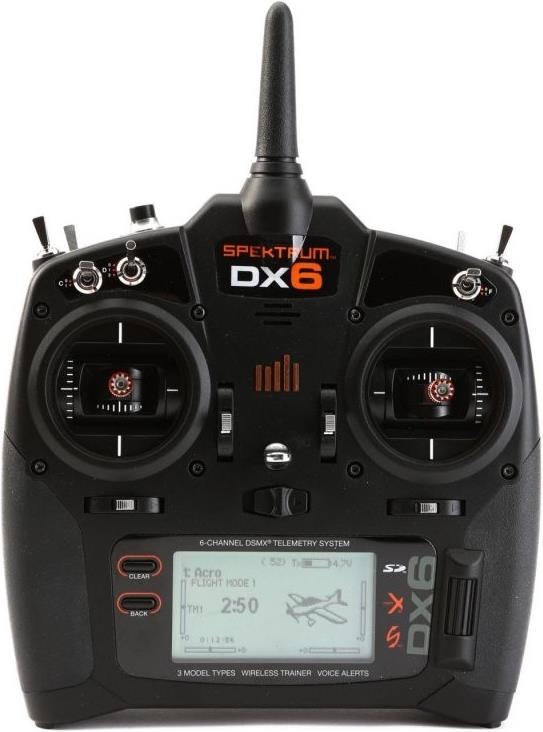
Spektrum DX6
I agreed and he told me to get a better remote control than the one included in the kit. He recommended the DX6 from Spektrum and showed me a Set including the remote and a reciever.
I ordered and got this huge tool full of switches and stuff. It’s a faster computer than the one I have at home ;)


Two weeks later we met on a hill with some other guys. Michael, that’s his name, is in an association of RC-Pilots. It’s mostly some middle aged men sitting together on a little air field, discussing this and that. Every now and then one gets up, takes his plane and does some turns.
Michael showed me how to propperly prepare the plane for the flight, reminded me to always turn on the remote before connecting the battery pack inside the plane and showed me the advantage of ailerons. It took me all afternoon to manage the plane the way they expected it of me. Every now and then someone gave me a tip but they were not pushy or stressing. It was a very relaxed afternoon and it was what it took to finally make me understand how to do some simple maneuvers. In the evening I was almost able to land the plane propperly. Almos because at the very last moment I confused left and right while the plane was heading towards me and it hit the ground. Still it did not hit the ground as hard as it did before.
Since that afternoon I’m motivated to do more. I applied to become a member in the Pilot Association, I tried to program multiple things on all those switches on my remote, I ordered new recievers so I can fly all my planes with one remote and so far.

Today then I took the Funman, my Multiplex remote and two battery packs and went for a flight. It was awesome. I finally manage to control the movements of the plane and every time I “landed” it without completely destroing it. I even managed to mount the mobius action cam and make a movie about it.

Samstag, 30. Juni 2018

How long still?

Project Kingfisher is about building a plane which is able to fly and dive into water and fly out of it again - just like the bird can. If possible, it should also be able to film it’s flight/dive.
To start, I am learning how to use a radio controlled plane. I thought it would be the easy part but actually it’s pretty difficult so I looked around and found somebody willing to teach me the basics. I’ll have my first lessons in a week.
Also I’m reading books about RC-Planes and how to construct them right now to get some background knowledge. Once I have sufficient information about planes and how they are built, I’ll dive into the matter of Submarines. I’ll have to learn how they are built, how they function and how they are commandet.
To gain experience with planes I bought five different ones. One is still waiting for repairings, two are completely destroyed and two are not yet assembled. All but one plane were for beginners so you can imagine how much more time it will take me to become an o.k. pilot and I assume it will not be much quicker to become an ok captain.
For the Planes I know now that there are several clubs around who also support you in training, insurance and who offer you an airfield. For the subs I have no Idea so far but I think these informations will come up as soon as I start looking.

For now I have tons of Ideas in my head. About how to cool an engine that is closed in an waterproof capsule while running as fast as a plane engine has to run. About the different propellers needed in the air and underwater. About how to change the weight of the kingfisher when it dives into water and about how to get rid of this added weight once it comes out of the water. About which and how many engines to use and about the force and size of the servos.
The longer I look into the different categories of the RC-World, the more I see and the more solutions I find. It’s a fascinating world filled with tons of things I still have to learn.
Project Kingfisher will - at the pace that I’ve taken so far - be finished not before the next two years.

Dienstag, 19. Juni 2018

Introducing the Newbies

After yesterdays crashes, demolished plains and foam parts all over the floor, today was the day to get new planes.

Tadaa:
The "Mini Trainstar” by Volantex RC. It’s tiny. It has a wingspan of 40cm and a lenght of 31cm. With its 20 gram it’s also super light. My first impression when I took it out of the box was that there is really no weight.
Something I have never experienced before is the 6-Axis Gyro. I know that a Gyro is used for filming to keep the Camera still but I did not know, that one can also hold it’s plane still with it. How it looks and how it works are yet to be discovered. What I can say from a first testflight is that it keeps your plane propperly still in the air and there is way less uncontrolled movement. Still I’m not yet familiar with the concept and I suspect the Gyro to take turns on it’s own every now and then.
Also I had my difficulties with the Elevator. Whenever I wanted the plane to rise, I just pulled up the throttle, because somehow the elevator showed no effect.
Afer all I came back from my test flight without any broken planes and some pretty nice landings. It might still be worth having this Gyro.


The T34 from Top RC Hobby. What a beauty. It’s wingspan of 75cm makes it bigger than the Mini Trainstar but it’s still small.
Here I’m a bit worried. The seller asked me if I was a beginner and of course I said yes so he looked at me with this sorrowful expression. He said this plane is quite wild.
I did not yet put it together nor unpack it further. It would really be a shame to crash it too soon. Instead I’ll take pictures of it as long as I can. It really does look good.

Montag, 18. Juni 2018

It did not


This glorious picture is symbolizing todays tests. At first I went out just with the woodman. I assumed, the glue specifically for Styropor would keep everything in place and it would just be a mather of aerodynamics and heat, wether the test would be a success or not. As you can see, it turned out differently. I started the plane with normal gas and the nose immediately began to sink. With a bit more throttle It came up again and right as I iniciated the first turn the wooden plate keeping the engine and the propeller fell off and the plane fell to the ground. All in all this took about three seconds.
As I’m used to by now, I went back home, charged the battery pack and prepared the woodman for repairing. Little did I know that they would have to wait.

As there was still daylight, I took the Shark for it’s test aswell. I remembered from the last flight that it liked to turn to the right even though I did not know why. It must have had a hard landing where something broke but with the repairings that I’ve done, I thought this’d be fixed.
As the Shark took off for the first time, it came to ground quickly in a sharp right turn. I adjusted the settings and let it take off again. This time, the Shark described a large right turn but it was impossible for me to correct it properly. Instead, as I got a bit stressed, I acceleratet the plane too much and it crashed violently. I had to collect it in pieces.

The Shark in pieces
The cabin fell off during the crash. This saved the camera which was installed on the pilots helmet. The nose that was already a bit weakened by previous crashes broke off and so did the engine. The propeller was lying somewhere in the grass and the wings took some cuts aswell.
All in all it is too much to repair. Especially the nose which I think was tilted to the right which caused the plane to always turn to the right, was so destroyed that I did not see any chance of repairings. Especially not after my glorious work on the Woodman was such a quick failure. 

As I am still far from being a good pilot I decided to order a new plane. This time it will not be Multiplex as I can not afford to continuously crash such expensive toys. I have to get something way cheaper. In the internet I found offers that are RTF ("Ready to fly” which means they are completly built and include all the necessary parts) and cost about a quarter of the Woodman. I ordered one and we will see soon, what differences there might be.

There is a video of the sharks two last flights but it’s really not entertaining and it lasts about four seconds so I’ll spare you this.